Tuesday, May 26, 2015

Canadian East Africans urged to invest back home

By Esther Essie Wambui (@westesita)~~~~~~
Diplomatic representatives from the five East African countries that also form the East African Community [EAC] met with investors in Toronto this week.
The East African Diplomatic Representatives: From Left-Right - Jack Mugendi Zoka (Tanzania), Ms. Umtoni Shakilla (Chargee d'Affaires for Rwanda), John L. Lanyasunya (Kenya), Speciose Nzeyimana (Burundi) & John Chrysostom Nsambu (Uganda)
The investors networking event was organized by Canada East-Africa Chamber of Commerce, with the aim of connecting the East African diaspora in Canada with their country representatives.
Ambassadors John L. Lanyasunya (Kenya), Jack Mugendi Zoka (Tanzania), John Chrysostom Nsambu (Uganda), Speciose Nzeyimana (Burundi) and Ms. Umtoni Shakilla (Chargee d’Affaires for Rwanda), collectively highlighted the varied investment opportunities and sectors that exist in EA.
From the outset, the diplomats individually underscored that their countries are not in competition with each other, but rather work together to promote common good for comparative advantage, common market ties and a move towards a common currency for the EAC.
Admitting that various social and occasional political challenges remain, the five nonetheless pointed out that the region economies were some of the fastest growing in the world.
It is the right time, they each stressed, for top Canadian investors to take advantage of favourable conditions to invest in the region. They welcomed tourists too, noting that the region was home to many world-class attractions.
High commissioner Lanyasunya accentuated that Kenya is an important player in the region, with a liberalized economy which among other business advantages has well-developed financial markets.
“The country is recognised as a regional banking, information and transportation hub with a huge pool of educated people.” He said. “There are, among others, investment opportunities within the ICT (Information and Communications Technology), agriculture, tourism and infrastructure – including regional roads, railways and pipeline construction.” He continued.
In his appeal to Canadians to invest in Tanzania, H.E Zoka stated that the country was at peace and has favourable investment conditions. He warned though of “the three declared enemies” of his country –ignorance, disease and poverty – which he said have to be overcome in order for Tanzania to grow into a middle-income county like their neighbour Kenya.
“There are still too many people living below the poverty line and this cannot be allowed to continue.” Zoka said.
Canada-EA2
The East African Diplomats with the Canada East-Africa Chamber of Commerce Executive & Board
In place of a formal presentation, Ugandan High Commissioner chose to do a Q & A. “With an estimated two million East Africans living in North America,” Nsambu urged diaspora East Africans to take advantage of their numbers and look into all possible investing opportunities. Presenting in French (through an interpreter), Amb. Nzeyimana of Burundi was quick to acknowledge her country’s current security situation, which she insisted was only temporary as it related to recent elections.  Listing many incentives put in place to encourage investment, Nzeyimana invited all kinds of investors saying that “there are a lot of sectors in Burundi that need foreign investment and expertise.”
Rwanda’s Chargee de Affairs, Ms. Umutoni presented Rwanda as “viable and enjoyable”, taking time to outline the many advantages of investing in Rwanda and the ease at which one could do so. She said that her country’s consistently increasing GDP speaks for itself.
Ms. Umutoni singled out Rwanda’s financial sector as a huge opportunity for investment, saying “…fifty eight per cent [58 %] of Rwandans have no access to formal financial services”.
On their part, host Canada East-Africa Chamber of Commerce encouraged East Africans to invest and spend money to improve the lives of people back home.
Speaking on behalf of the Chamber, financial advisor Preetum Anauth addressed opportunities in the stocks market; noting that the East Africans living in Canada know these countries and can identify particular companies to invest into.
Referring to the touting of the 21st century as Africa’s century (economically), Anauth pointed to the beginning of this decade, when African growth rates have exceeded those of the world in general.
“There are salient features that make the East African stock market very attractive,” he said. For example, the Nairobi Stock Exchange (NSE) is a frontier market that shows resilience, continued performance and growth potential. Dar es Salaam Stock Exchange (DSE) on the other hand had shown increased liquidity with more shares traded each year as compared to the year before.
Anauth alluded to recent and future developments that should make people more comfortable investing in East Africa: Cross listing of companies in the different stock exchanges, cross listing in the London Stock Exchange and the region’s soon to be launched Exchange Traded Funds (ETF).
The Canada East-Africa chamber of Commerce is a not-for profit business organization that promotes trade, tourism and investment opportunities between Canada and East Africa. These business opportunities are in banking & finance, energy & mining, travel & tourism, building & construction, agriculture, manufacturing, infrastructure, environment and natural resources.
Watch video clips here: https://www.youtube.com/playlist?list=PLGf5rV5Tre1tZ1xFsLX3n5JlHJcfbQsws
 – By Esther Essie Wambui (c)  @westesita
For Canada East-Africa Chamber of Commerce

Friday, May 8, 2015

Education is President Obama’s Grandmother’s Passion

By Esther Essie Wambui (@westesita) ~~~~~~
Mama Sarah Obama in Toronto, Ontario, Canada
She is proud of her grandson.  After all, he is the President of the United States of America, a position whose holder is considered to be the most powerful person in the world. 
But at the moment, that’s not what she wants to talk about; although she kindly acknowledges that the name recognition has definitely opened a wider stage for her to expand her cause.
Instead, she would like to focus our talk on Education – her great passion – education for the vulnerable and orphaned children from her Kogelo community in Kenya.
Dr. Mama Sarah Obama, or Mama Sarah as she prefers to be called, principally came to Toronto as a guest of the Goodlife Fitness Toronto Marathon. But various groups and individuals have since organised to meet the pleasant community champion.
The 94-year-old grandmother’s packed itinerary defies her age. As the patron of Safeguard Orphans and Widows organisation (SOWO), Mama Sarah is using her short visit to seek support for the NGO.
Her work within the community of Kogelo started long before the Obama name became world-famous. In the last three decades, HIV/AIDS has ravaged Sub-Sahara Africa, resulting in millions of orphans. It was in these years that Mama Sarah turned her attention to the welfare and educational needs of these orphans and their poverty-stricken families.
“I like to see children get an education, so I help the orphans, especially the young girls who have been orphaned because their parents died of HIV,” she says. “I not only encourage them to continue with school, but I also, with support from others, help them with school fees and other necessities including school uniforms, pencils and books”.  She tells me in Swahili.
President Obama’s last surviving grandparent, whom he fondly refers to as “Granny” in his memoir Dreams from My Father, tells me she never herself went to school. Mama Sarah, who was a stepmother to the president’s father, Obama Sr. says she raised the elder Obama since he was 9 years old. 
Mama Sarah Obama with friends Carol & Thomas Nzyimi at their home in Toronto, Canada.
Mama Sarah Obama with Carol & Thomas Nzyimi in Toronto, Canada
“In those days, when I was born,” she reminisces, “it was very hard for girls to get an education. Only boys were allowed to go to school, and that is why I’ve always pushed to get children within my family and community through school”.  She says.
For longer conversation, Mama Sarah spoke in her native Luo, while Dr. Kenneth Kambona, a development consultant based in Nairobi served as interpreter. Dr Kambona is currently working to define the strategy for Mama Sarah’s SOWO programs.
“She says that since HIV/AIDS has affected many families in Kenya and Africa, she urges Kenyans in Canada and elsewhere to be keen in their support efforts to alleviate the need.” He interprets.
“Mama says that the work she does requires a lot of support from others, so we use such events to galvanize supporters and donors,” Kambona says. “Many people don’t realize that when a family loses the breadwinner, they are left without many options. Widows require a decent basic livelihood. They need some money for themselves and their daily needs.”
Over the years, Mama Sarah Obama has been at the forefront of championing the plight of orphans, the girl-child and widows, for which she has won various international awards including UN Women Education Award in 2014.
“Some of the many children I have helped educate are now in universities.” She says with a shy yet open smile.
I wouldn’t let Mama Sarah go without asking her to let me in on the secret to her energy and vibrancy at 94. Without hesitating, through Dr. Kambona, she attributes it to God’s blessing.
“God has given her the strength and wisdom to continue to this date. So she’s very grateful to God.” He says.
 – By Esther Essie Wambui (C) @westesita 

Sunday, April 12, 2015

Ontario Kenyans mourn victims of Garissa University Attack

By Esther Essie Wambui (@westesita) 

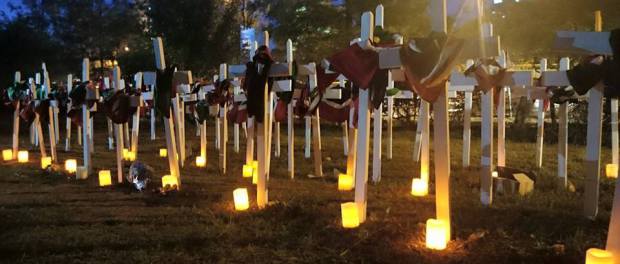
Kenyans living in Ontario gathered in Toronto on Sunday April 12 to mourn the 148 people killed when al-Shabab terrorists attacked Garissa University 10 days ago.
Names of the identified Garissa victims were called out

The interfaith ecumenical prayers service held at the Consolota Missionary Centre, paid tribute to both the dead and injured victims of the attack and said prayers for their families.
Attending the ceremony was the new Kenya High Commissioner to Canada and Cuba, ambassador John Lepi Lanyasunya, who also took the opportunity to introduce himself to the Kenyan community.
Attendees included Ambassador & Mrs. Lanyasunya and CIC chair Charles Nyachae
Addressing the congregation, Amb. Lanyasunya underscored that Kenya has been and would continue to be a beacon of peace for the region.
He pointed out that by attacking Kenya, al-Shabab intended among other reasons to divide Kenyans. “By isolating and killing Christians, they want to sow seeds of discord among various faiths.” He said.
Leading the prayers were various community and religious leaders
Community and religious leaders lead the prayers
Emphasizing that the constitution of Kenya guaranteed freedom of worship for every citizen, the Ambassador urged Kenyans to not fall into the trap of division, but instead stand together irrespective of their religion to defend this freedom. While noting that Kenya had developed into a medium economy country, Amb. Lanyasunya impressed that by attacking Kenya, al-Shabab was also aiming to cause economic difficulty for the country. Pointing at various travel advisories issued against Kenya by certain countries, he pleaded with Kenyans to repossess the economic narrative of their country.
“Kenya is a peaceful, united vibrant county,” he said. “an open economy where freedom of speech, religion and expression is allowed for all.”
Afterwards, East African regional leaders joined in a planting of seeds ceremony symbolizing Kenya’s enduring spirit. This was done alongside the calling out of the names of all identified victims.
A n excerpt from the poem Grass will grow by Kenyan Poet Jonathan Kariara was  recited.
In attendance too was chairman of the Commission for the Implementation of the Constitution [CIC] Charles Nyachae.
Mr. Nyachae, who happened to be in North America when the attack in Garissa took place, urged Kenyans to individually and collectively help root out terrorists from their communities.
“Let each one of us be able to say that we have done our part.” He implored.
The service was organized by Kenyan community and religious leaders in Ontario.
         -By Esther Essie Wambui for Wakenya Canada  http://wakenyacanada.com/ontario-kenyans-mourn-victims-of-garissa-university-attack/
Here is the poem Grass will grow by Kenyan Poet Jonathan Kariara [1935-1993]
If you should take my child Lord
Give my hands strength to dig his grave
cover him with earth
Lord send a little rain
For grass will grow
If my house should burn down
So that the ashes sting the nostrils
Making the eyes weep
Then Lord send a little rain
For grass will grow
But Lord do not send me
Madness
I ask for tears
Do not send me moon hard madness
To lodge snug in my skull
I would you sent me hordes of horses
Galloping
Crushing
But do not break
The yolk of the moon on me.
 –Kinnareads.com

Wednesday, April 8, 2015

#147NotJustANumber

#147NotJustANumber - Photo Courtesy Henry Ndirangu.
A partial list of names of those murdered at the Garissa University College attack in Kenya on April 2, 2015.


Credit: http://wakenyacanada.com/147notjustanumber/

Tuesday, August 5, 2014

Lessons From a Scarred Tomato

The scarred yet sweet & juicy tomato
This is a special tomato. 

"Why would such a blemished and imperfect tomato be special?" You might ask. Let me explain: This tomato is special for the simple reason that it’s picked from our garden. I grew it. Planted in early May, we gave it TLC for three months till harvest time in August.

I wouldn't buy this tomato or any that looks like it. I spend time poring over produce at the grocery store to ensure no blemished fruit or vegetable makes it to the counter with me.

For one, fresh produce is expensive and whatever we buy is meant to last a while, sometimes for several weeks, and the scarred ones won’t. Even when we intend to use them quickly, the mere task of cutting off the scarred parts seems like too much work. While grocery stores go to great length to ensure only perfect produce is displayed, picky shoppers still take time to skip even the most of superficial scars.

I brought this tomato in and it did not even for a minute occur to me to throw in out. “It’s mine and it’s organic.” I reasoned. Plus, I know that after cutting out the scarred section, it will blend in and be unrecognizable among others in the salad.

This got me thinking about faults and weaknesses. People's everyday weaknesses or annoyances [I am not talking about drama, which I prefer to keep it out of my life]. We’re very quick to see fault in others - be it family, friends or colleagues. Regardless of the depth of the fault, we tend not to care that the fault could be as a result of their circumstances and/or previous experiences. After all, these contribute to molding our character.  Once we identify in others something that displeases us or makes us uncomfortable, then we rush to judge and dismiss. “She’s not my type” or “he’s just too complicated” or they are just “too challenging to deal with”, are some of the arguments we front to justify disengagement from people we should care for and who generally need more care than most.

When we do this, we throw out an opportunity to be human, to show kindness, to forgive and to be an example to others. We shut the door to being vulnerable with others; an important ingredient for friendship and close family relationships. Instead of covering others or helping them cut out faults, we expose their difference, their lack and weakness. We distance ourselves from those we perceive to be weak and different.

This is classic human hypocrisy since as we are judging and criticizing others, we fail to see or acknowledge our own weaknesses. Consequently, when we do acknowledge it, we’re rather quite forgiving of ourselves and want to make others believe that it was a rare mistake or a judgement error and that we’re good most of the time. We also promise to improve ourselves.

Drawing from Scripture, it appears that Jesus was not impressed by the “clean and righteous”. Rather, He identified and reached out to the marginalized, the ones that society had kicked to the curb. The sinners and imperfect were his closest; whom He chose, engaged in conversation and shared meals with. Those are the ones we too should seek out.

Remember, after I cut out the blemish, the salad tasted just as delicious.

Friday, June 20, 2014

Delicate Northern Summer Blooms

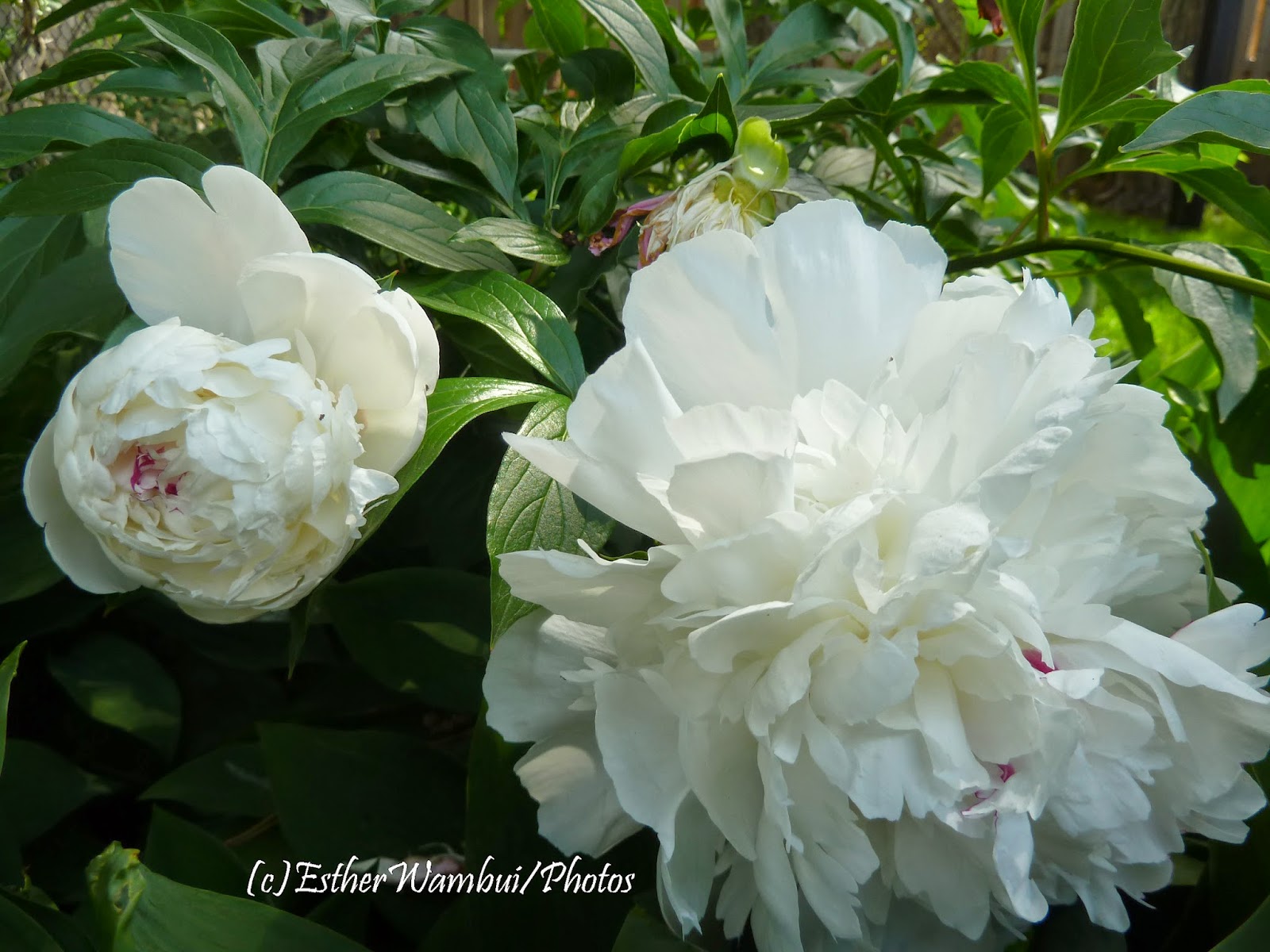
A pair of fresh & beautiful white peonies

These light pink peonies appear so fresh in the morning.

The tiny spider webbed a home in these beautiful surroundings

Peonies are delicate and don't bloom for long and this hot pink one seems to die up first.

Thursday, May 29, 2014

Basking in the Agony of Spring

Spring is here or to be more cliché “spring has sprung”.


I always look forward to spring. Living in the North makes you constantly watch for those first buds. It is pure bliss and radiance when they appear, yet with it comes the agony. Allergies - the sniffles, itchy throat, watery, red eyes, etc. The worst part is, while sometimes the allergies last for just a couple of days to a week, it can sometimes stretch for weeks on end. Sometimes the allergies outlasting the season, stretching into summer.

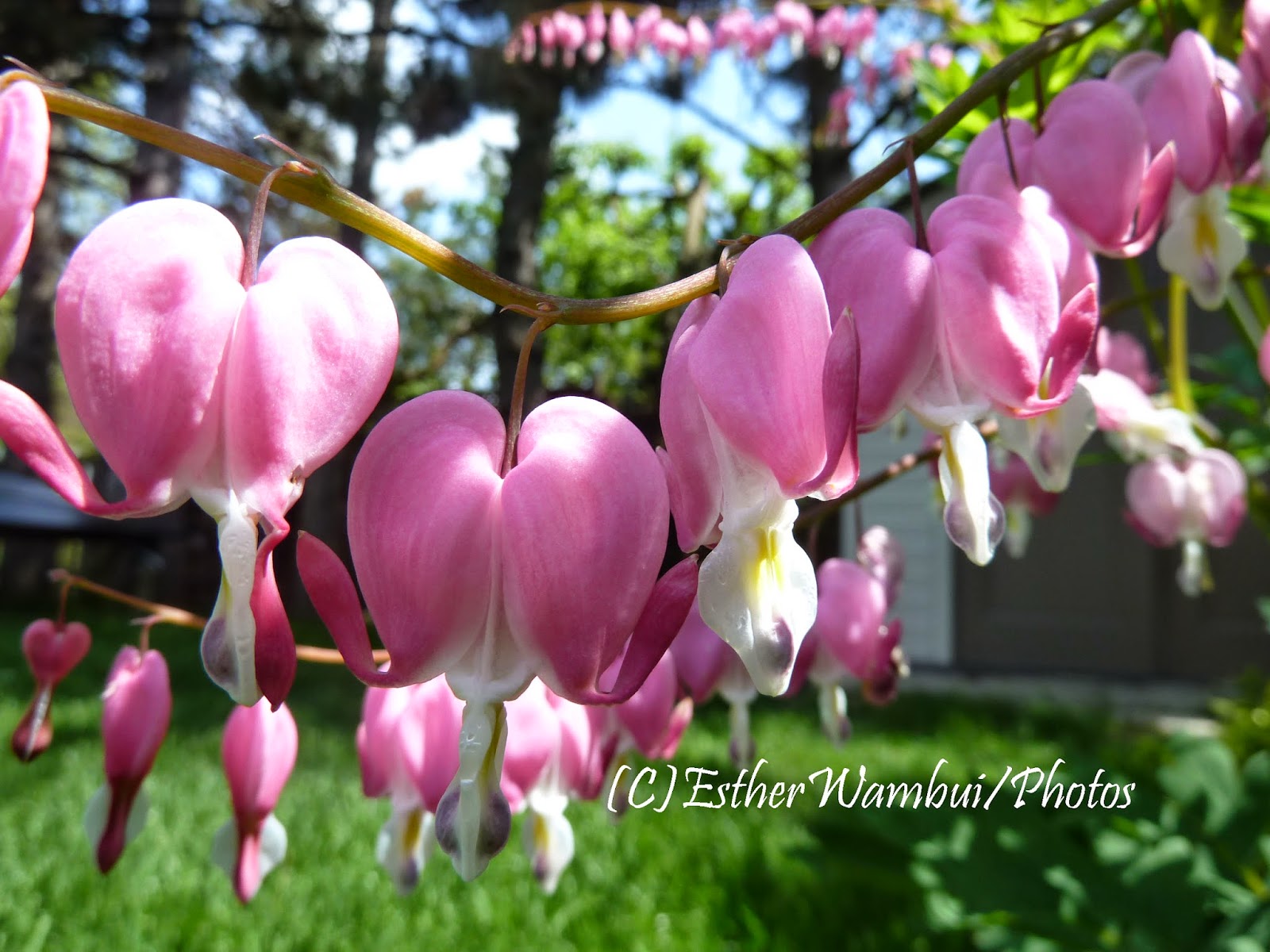
Bleeding Heart: Could there be a more appropriate name?
Still, I never wish spring away. Its cool temperatures, colourful & vibrant beauty coupled with enticing scents make it worth all the discomfort. I don’t have allergies severe enough to require anti-histamines but I constantly need eye drops. On calm, less windy days, I can generally enjoy the outdoors.

Lilly of the Valley: A Spring delight that smells as good as it looks.
Let’s enjoy spring before the Fall allergies send us rushing back indoors.

Tuesday, September 25, 2012

Wildfires Plague Ecuador

I have never been happier to see the rains come. Disregarding etiquette and discomfort to my neighbours, I cheered loudly, thanked God and walked a little in the rain to celebrate the relief. It has been very dry here. There has not been a drop of rain for months and Ecuadorians have taken to looking into the skies daily for a sign of darkening clouds.

The summer of 2012 brought devastation to Ecuador with fires double the average for the period in the South American country.  Thousands of hectares of forest have been burned since a series of fires started in the province of Pichincha, according to the country's Ministry of Environment.
So far, forest fires have killed five people and left 73 injured, consuming hectares of woodland, scrubland as well as crops. In all it was reported that there have been more than 3000 wildfires since June 1, when a period of drought set in.

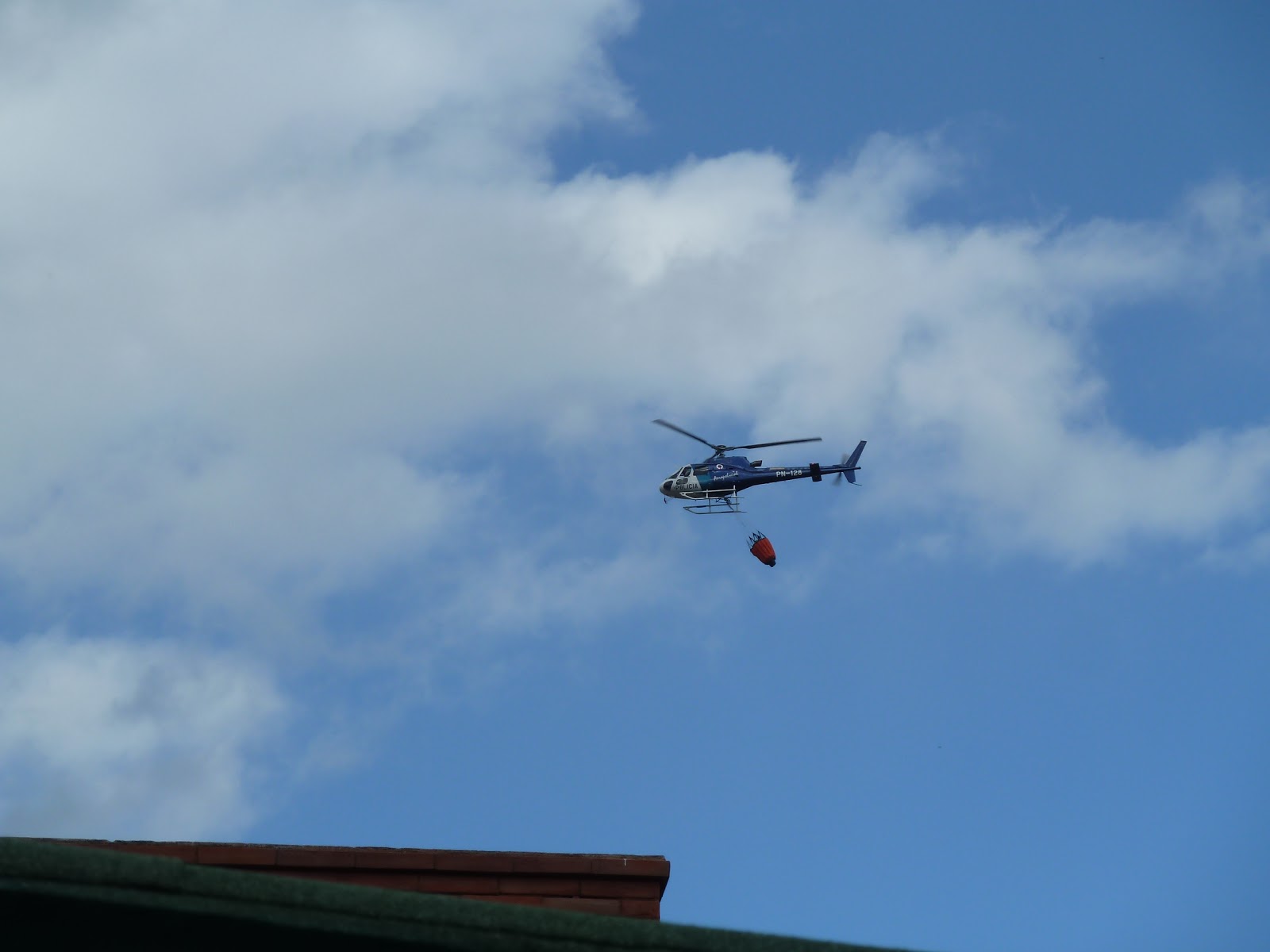
A police chopper on duty
EstherWambui/Photos
Military chopper on fire-dousing duty
EstherWambui/Photos
The most affected provinces were Pichincha [where I live], Azuay, Bolivar, Chimborazo, Cotopaxi and Tungurahua.
The Ecuadorian armed forces deployed aircraft; helicopters and planes, as well as soldiers, to fight the fires. Even neighbouring countries including Brazil, Chile, Colombia and Costa Rica have sent in crews to help extinguish the flames.

EstherWambui/Photos
EstherWambui/Photos
EstherWambui/Photos
Although most people living in the Suburbs have not been directly affected by these fires, the constant smell of burning wood and billowing smoke from all directions has been hard to ignore. I have been constantly also reminded of the fire by the frequent sounds of helicopters flying above my place. I happen to live by the valleys’ only reservoir, where helicopters came by the minutes to collect water.

Ecuador’s topography, which is mostly hilly and mountainous, made it very difficult to quickly douse the flames and evidence of the fire is everywhere you go. Hopefully, with the rains, new vegetation will cover the blackened hills and forests and clean the reminders of a painful summer.


Link to Video: http://www.youtube.com/watch?v=XlTvFoLGI-U

Sunday, September 23, 2012

Ecuador Summer 2012 Wild fires

http://www.youtube.com/watch?v=XlTvFoLGI-U

Ecuador is experiencing devastating forest fires. According to news reports and anti-disaster officials, there have been 3069 forest fires since June 1, when a period of drought set in. The fires have wiped out 17,484 hectares of woods and scrubland high in the Andes as well as 142 hectares of crops, while another 31 hectares of crops were affected but not completely destroyed.


At this reservoir in Cumbaya, Quito, water bombers fill up for their seemingly unending task.

Friday, July 20, 2012

Kenya; a world leader for mobile money - World Bank

I am sharing this article as it aligns with my thoughts; that the best change in developing countries originates from within.


How Kenya became a world leader for mobile money

Submitted by Wolfgang Fengler on Mon, 2012-07-16 14:37
What if anyone owning a cell-phone, whether rich or poor, also had access to financial services with the ability to save and send money safely, no matter where they are located? This is not science fiction; in fact it is already happening in Kenya, which has become the world’s market leader in mobile money.
Today, Kenya has more cell-phone subscriptions than adult citizens and more than 80 percent of those with a cell phone also use “mobile money” (or “M-PESA” which is very different from “mobile banking” as Michael Joseph–the former Safaricom CEO, and the man behind that revolution—can explain passionately!).

Internet access is also increasing rapidly, even though many are complaining about poor service by some operators. Within the next two years, Kenya could become one of the most connected, and modern economies in the developing world, and a unique case among the world’s poorer countries, that have an average annual income of below US$ 1000 per capita (see figure).
Figure - A Kenyan revolution: more phones than adults

Source: World Bank calculations based on Communication Commission of Kenya
While the telecom revolution is not unique to Kenya, mobile money is. There are approximately 60 million mobile money users in the world, which means that almost one in three is a Kenyan. Half of all mobile money transactions are taking place in Kenya where annual transfers are now around US$ 10 billon.
The emerging social and economic impact has been remarkable. Businesses can operate more effectively: shop-owners don’t need to carry a lot of cash, or to stand in long queues at Banks to transfer money to suppliers. Urban dwellers no longer need to make overnight trips to their rural homes to pay their children’s school fees (or give money to relatives). Women have been empowered because their husbands have a harder time taking their money away. Even macroeconomic policy has become easier because the Central Bank has a better handle on the money in circulation, as mobile money helped to move cash from the mattresses to the market.
The success of mobile money in Kenya should be a source of national pride: it gives the country a global profile, which is only matched by the successes of its long-distance runners.
But Kenya’s global leadership in this area is also puzzling. Even Hillary Clinton wondered why this “brilliant innovation” is not available in the USA. How come mobile money has not yet taken off in other countries, especially those where money transfers from urban to rural areas are enormous even by Kenyan standards? If it is so beneficial to customers and operators, why have they not sought to replicate Kenya’s success, given that replication is so much easier than innovation?
There are three main reasons why mobile money took off in Kenya, while facing challenges in other countries (even though the India, Philippines, Nigeria, Tanzania and Uganda have started to catch up).
First, Kenya’s regulators enabled the mobile money take-off. The Central Bank in particular played a very progressive role and allowed “regulation to follow innovation”, while reassuring the market of its oversight. The regulator agreed that mobile money agents needed only limited requirements to enter the business, as they were not providing banking services, while the operator behaved as if it was regulated and periodically reported financial and usage data as Banks do.
Second, the strategy of the omnipresent operator – Safaricom – was also important. In 2007, the company already had more than 50 percent market share. Its strong position and national presence helped it to reach scale. But when replicating mobile money in other countries, such dominance by a single operator is not a precondition for mobile money to take off: many alternative models can also lead to success such as “third-party platforms” into which operators connect to. Even more important was the company’s business philosophy to “build a brand rather than make quick return”. Indeed, it took some three years until M-PESA generated a net-profit. However, it created indirect benefits from the beginning because in Kenya’s increasingly competitive market, mobile money boosted loyalty and attracted new customers to its core business of voice and SMS.

Third, Safaricom’s management understood that the success of M-PESA was ultimately about people management, not technology. Many innovations fail because management focuses exclusively on designing and launching a product, and assume that technology will take care of itself afterwards. The opposite is true. You need people to run machines and the interactions you get after product launch can generate even better products. The true secret of M-PESA’s success is the management of the agent network, which grew from 300 initially to almost 30,000 today.

There is no doubt that mobile money will soon go global, especially if countries consider the lessons from Kenya. In the whole world, there are still more than two billion people who have cell-phones but no Bank account: for these, mobile money is an extremely attractive proposition.
-----------------------------------------------------------------------------------------------------
Note: This article draws on a forthcoming paper titled “Scaling-up through disruptive business models - The inside story of mobile money in Kenya” (by Pauline Vaughn, Wolfgang Fengler and Michael Joseph) which will be published by Brookings as part of a book project on “Scaling up for development impact”.
Source: http://blogs.worldbank.org/africacan/how-kenya-became-a-world-leader-for-mobile-money

Thursday, April 12, 2012

Racism the Latino Way

Is there racism; are Ecuadorians racist? I’ve been asked this question numerous times. I didn’t address this question yet as I thought I should first understand the country and its people deeper - looks can be deceiving. I can quote a number of reports and research papers that show people of Afrodescent [Afro Ecuadorians] and Indigenous groups face some form of discrimination or other. Historically these two groups have generally had little if any share of economic opportunities compared to the mainstream Eurodescent population.   Ecuadorians from these groups are the only ones who will admit that racism exists in their country. Now I can say and anecdotally illustrate that racism is widespread in Ecuador.  It appears that racism and classism play off each other, feeding on racial stereotypes.

At the beginning of this year, I found myself taking the same course with another Canadian. We got talking and started sharing about our experiences here. He has lived in Ecuador for five years and is fluent in Spanish. One day, our discussion led to skin colour. Then Terry leans to me and says, “Do you want to hear an unpleasant story about skin, as in skin colour?" I am always eager for a story so I told him to leave no detail out.
Terry, like lots of other people I know here has been robbed. Not once but twice, plus two attempts. One of the ‘successful’ robberies involved a large sharp knife. He told me the saddest part was being robbed in front of a military complex, where guards with sub-machine guns watched and did nothing. This is nothing new – generally, Ecuadorians don’t intervene or care to interrupt a robbery [I had to rant about that]. He told me that he was so pissed off he asked them why they didn’t help him and they had nothing to say. But they did lend him their phone to call the police.

After the police arrived, he went through the normal routine of recounting what happened and since it was still light outside, they decided to take him in their car and drive around the neighbourhood in the hope that he might identify his attackers. Eventually, they saw a guy just walking down the street and they stopped and asked Terry if that was the culprit. To which Terry answered no. This happened two more times and by this time, my friend was so mad he asked to be let off the vehicle right there. He had soon realised that the two policemen didn’t care for his description of the muggers. For those three stops, it had been when they saw black guys. My friend swears the police didn’t misunderstand him. He had sufficiently and clearly described the guys as Mestizos.
But between me and him, we wondered whether that was a common thing or they were just doing that for his benefit. Terry is what Ecuadorians call a ‘gringo’ and Ecuadorians are aware that racial profiling happens in North America, where they also believe racism lives.

The other times have to do with me:
I had some friends visit me from Canada; one is of Latin American descent while the other friend is Caucasian, blond hair blue eyes. They left the ‘urbanizacion’ [gated community] by taxi and decided to walk back. I hadn’t anticipated that and so the guards were not forewarned to expect them. The sad part is that while they walked in together, the guards only stopped and enquired about my Latino friend while they let the Caucasian one go through with a shouted greeting.  

Then recently, the ‘urbanizacion’ changed security companies. It’s a big community so of course I didn’t expect the guards to recognize all the residents yet.  As I walked outside the gate they stopped and questioned me. Afterwards, I hang around to see how many other people they stopped. None. This made me so furious I gave them a piece of my mind [in very broken Spanish]. But as we talked, it occured to me that they are just not used to and don't expect black people to be living in such communities.
But, that’s Ecuador for you, where people look at you and treat you differently, but attitudes change as soon as they realise I am an ‘extranjero’ [a foreigner], and not from Columbia or Cuba, where most foreign black people originate. They treat you differently when they realize you haven’t grown up in the system and you could be their equal or more in education, career, exposure, etc.

So, racism and discrimination are rife here; and classicism through prejudice is used to treat people differently.  This is no Kenya [where the determining discrimination factor is tribal]. It’s not Canada or South Africa either, where racism exits but shows up differently.  The fact is, like all these places, the victims of racism and discrimination are poor and have been poor for a very long time. Black people are assumed to be uneducated, and the only place they’re expected to shine is in ‘futbol’.  But, there is a bit of hope as the government, starting with the ministry of foreign affairs is catching up on affirmative action for the underprivileged groups.

This short 2009 report by Aljazeera illustrates the issue of racism against Afro Ecuadorians: http://www.youtube.com/watch?v=6AE27JSZIJw

Sunday, April 8, 2012

Easter in Quito – No place for Easter bunny or eggs

Pictures by Essie & M Futkowski. 
Easter and Semana Santa is a good time to be here as it is packed with religious, cultural and art events. Unlike Christmas which I found a tad bit too bland, the Holy week is far more emphasized and the best time to experience an elaborate outward expression of the Christian faith and Catholicism, imbued with elements of Andean culture. Semana Santa, my second in Ecuador, begins on Palm Sunday with the blessing of the palms and ends on Easter Sunday with a solemn mass of the Lord’s Resurrection.


The statue of Black Jesus
Cucuruchos march on
A penitent adorned with barbed wire
Women penitents take part in the
procession

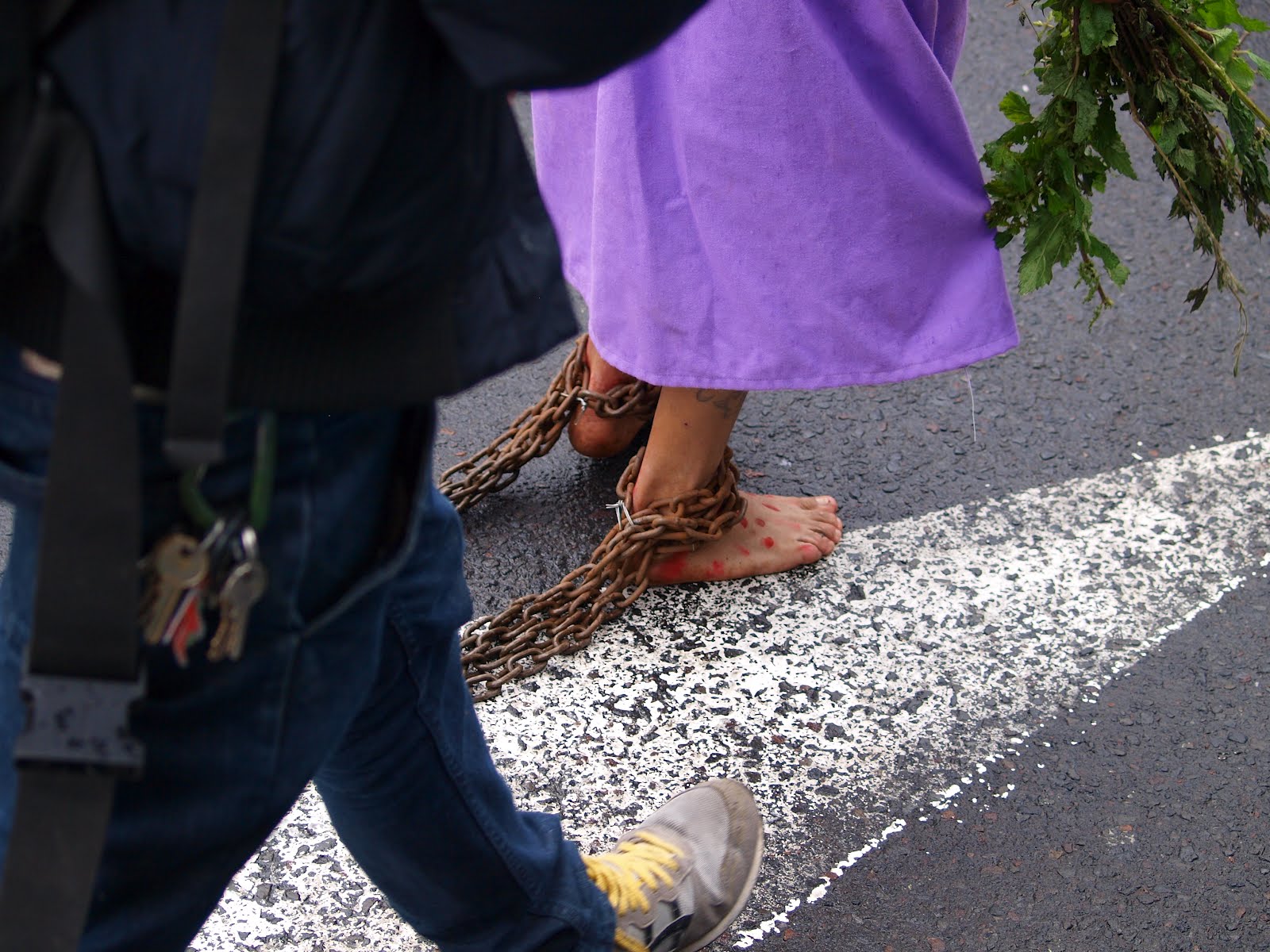
The heavy chains
 The highlight of the week is el Jesus Gran Poder [the Almighty Jesus] Procession on Good Friday. Although a Christian, this was for me a very different and moving experience. The Quito procession is the second largest Good Friday procession in the world, second only to Seville, Spain. Here I saw Ecuadorians physically manifest Christianity. I saw and felt an almost tangible faith on the faces of young and old, men and women who whole-heartedly embrace their faith.

As it does each year, the procession began and ended at the San Francisco Cathedral with thousands of citizens dressed in distinctive purple costumes, some, cucuruchos, wearing conical pointed hats. A band led the procession and several other bands throughout the procession played sombre music, mourning Christ’s passion.  Faithfuls gathered and walked, majority in bare feet. Robed and masked men, women and children carrying religious artifacts [crosses, candles, rosaries, pictures of Jesus, etc.], walked the four mile route.

One of the designated Christs caries a
giant cross - he occasionally needs help.
Among the penitents walked tens of designated “Christs” carrying such huge wooden crosses that they ocassionally needed help from others especially to walk uphill. Some people walked with their children, who seemed all too eager to take up the tradition.  Spectator family members and friends stood by the sidelines, occasionally shouting an encouraging word or passing a chilled bottle of water to the penitents. Smaller groups of women, whose costumes included a veiled face, marched in the procession as well.   

As part of the costume, these legions of faithful penitents carrried thick ropes around their necks, some carried smaller crosses and crucifixes, some wore barbed wire around their torsos, while others dragged heavy chains tied to their ankles. Some walkers carried signs asking [praying] for mercy and I saw a number of people on wheelchairs.

Yes, that's unshaved cactus. Ouch.
Two prominent guests of the day are greeted with cheer and praise. The famous statue of Black Jesus which resides in La Compania [the all gold interior Cathedral] and the statue of the virgin [I have to confirm the name], which were carried in the procession.

Including children in the celebrations
is one way to ensure the tradition
lives on. 
It’s also business time during the procession. Vendors walk up and down the streets shouting; “paraguas, caramellos, dulces, agua potable,…” above the music and loud speaker notices, trying to sell their wares - umbrellas, sweets, sugared corn treats, chips, fruit, bottled beverages and even plastic stools for people who can’t stand for long periods.

Such religiosity may not be everyone’s cup of tea. But for me, this outward expression of deep faith was a very humbling experience, as it totally centred on Jesus Christ as the pure reason for Easter. I also liked seeing uniformed policemen proudly take part in such a religious procession. Guess it’s not a big deal in a country that is 95% Catholic and most people wonder what if anything at all, the Easter bunny has to do with this special and holy week.
 
It’s time for some fenesca, the Ecuadorian Easter soup.
** Fanesca is a special Ecuadorian soup served only during the week leading up to Easter. It is an elaborate, rich soup made with 12 different beans and grains (to represent the 12 disciples). Salt cod (cooked in milk) provides the protein, since this soup is consumed during Lent, when many Latin American Catholics abstain from eating meat. It's usually served with fried plantains, hard boiled eggs and empanadas (floating in the soup or on the side)**.


Thursday, January 5, 2012

Fiesta de Año Viejo & Feliz Año Nuevo

In early December, around the same time nativity scenes start appearing, stores also stock rows upon rows of dolls and effigies. These range from tiny to life-size, made to represent famous and infamous people, political figures, folkloric characters and disliked people including foreign leaders.  


Masks
Courtesy:Ecuadoratyourservice.com
All this is in preparation for the Fiesta de Año Viejo, which has as much to do with the passing of the old year as the ushering in of the new one. I’m always looking forward to any holiday in Ecuador, as they have traditions and customs unlike anything in my life, both in Kenyan or in Canada. So as the year drew to a close, I couldn’t wait to experience it all.


Masks
Courtesy fotografiadelecuador.com
As I am learning along the way, Ecuadorians are as superstitious as they are religious, and they incorporate these believes in all their traditions, and the Fiesta de Año Viejo is no exception.

1). Año Viejo
While some people buy the ready-made dummies, most others actually create their effigies which they stuff with old clothes [ideally from each member of the family], saw dust, dry grass, newspapers and firecrackers. The assumption is that these effigies trap all the bad things from that year. These dummies are then beaten [people take turns] and then burnt before midnight to ensure those bad things are gone and will never happen again.  We sat close to our effigy to ensure it burned completely or else, as I was told, all the problems and bad things that were troubling you in the year would return to bother you in the New Year.

2). Jumping over the fire 12 times
The other tradition I took part in was the jumping over the fire.  This is how it works. Before midnight, you build a huge fire [not the effigy fire], and every person jumps over the fire for every month to bring good fortune/luck.  The problem with this one is depending on how many people there are the fire gets pretty big and very few if any can make the jump up to the 12th month. I didn’t make the jump past the 4th month.

3). Gifts to the fire
In this tradition, Ecuadorians throw coins to the fire for financial luck in the New Year or food stuffs like rice or flour to wish for abundance of food.

4). Coloured Panties
My friend Elizabeth first told me about this one in early December, and in preparation we set off to the city to buy some coloured panties but ended up with shoes instead. For New Year’s Eve, women wear coloured panties to bring good luck in the New Year. While red brings love, yellow is supposed to bring wealth – I will make sure to stock me some yellow underwear in future.

5). 12 grapes


My 12 grapes, and a piece of
chocolate I sneaked in.


I actually knew of this tradition from a Mexican friend in Toronto. Twelve grapes has its heritage in Spanish culture so it is widely practiced across Latin and South America. This is done at the dinner table so I found more people who said this was their preferred way to usher in the New Year, and I have to say it’s something I have decided to incorporate in my New Year celebrations from now on, substituting grapes with other locally available fruits. For every wish per month, Ecuadorians eat a grape [i.e. January find a job, February fall in love, March lose some weight, etc.]
6). Widow of the Old Year
This one is left to the children, although some adults though rarely do take part. My classmate Jorge explained this to me and said as a boy he played the widow. Neighbourhood children especially boys come together and select one to dress up as a grieving widow.  Then they set up barriers to stop cars and ask for money for the widow whom they refer to as the “oldie”. In the meantime, the widow plays up the part, weeping that their loved one has died and they have been left without money.

You have to give some money for the barrier to be released and the kids are happy with just a few cents. The barriers are expected at this time of the year and locals warn you to have lots of change while driving around. This tradition brings lots of fun for the children and people willingly play along, and the kids take home lots of change.

So tell me, which of these festivity most appeals to you?

Note. Año means year, Viejo-old, nuevo-new.

Thursday, December 29, 2011

Merry Christmas from Ecuador

Christmas Day in Ecuador is a day for family, and exchanging gifts is very important. Actually, one of the first items to appear on supermarket shelves is an assortment of gift baskets of various sizes that employers ‘are expected’ to buy for their workers. Contents range from a bottle of wine, to cooking oil, rice, spices and other food items. 

Having decided to remain in Ecuador for Christmas holidays, I was rather eager to experience their celebrations. In Quito, my friends told me that festivities tended to be personal and although traditionally religious they incorporated civic celebrations as well.

My pesebre.
Early on in December you start to notice nativity scenes called Pesebres [sometimes clothed in traditional Ecuadorian costumes] erected in various locations including parks and church compounds. These are very elaborate and in fact for most homes, pesebres take the place of a Christmas tree. I made sure to get myself a pesebre. All around in parks and plazas [town squares] people hold Novenas, which are public gatherings where people perform religious hymns and prayers.
Christmas Eve is Nochebuena, and families gather for dinner [cena de Nochebuena] which may traditionally include  turkey or chicken, salads, fruits, selected cheeses, rice, wine or the local drink chicha. I had a turkey cena de Nochebuena with a lovely Polish-Ecuadorian family, which was prepared by a black Colombian maid [interesting demographics here].  I did not attend the midnight Misa del Gallo, the Christmas Eve mass, which I later learnt is the highlight of the Christmas prayers.   


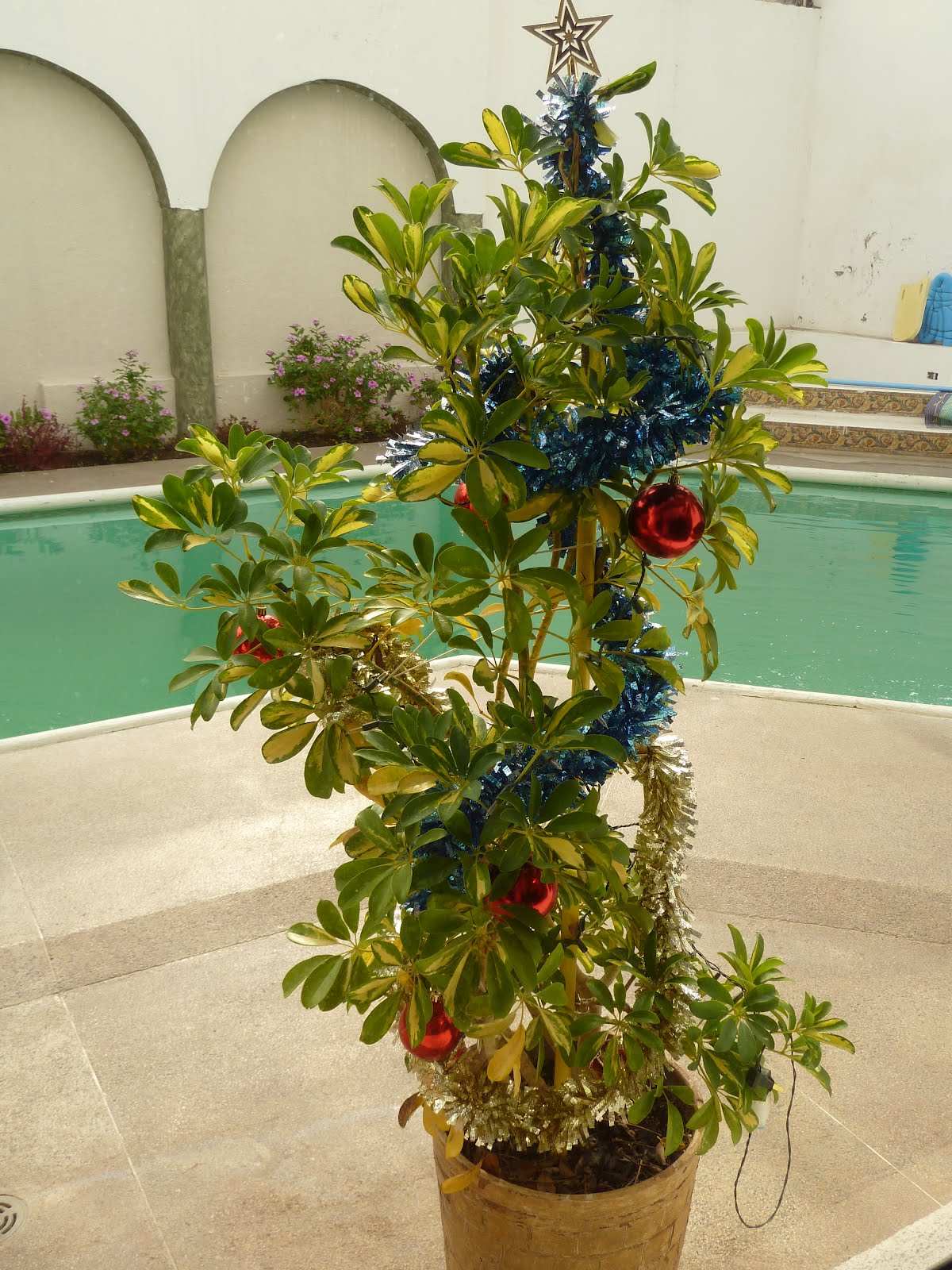
We turned this house-plant
into a christmas tree. 
Christmas Day as I pointed out earlier is a family day, to visit and exchange gifts. Had I really understood this, I’d have attended the Misa del Gallo and avoided the disappointing, sleepy Christmas day service. We even tried mass in two different churches, hoping for ‘vibe’ and life, but we found rather ‘ordinary’ rushed services, with more empty pews than not, of sleepy-looking people. It didn’t feel very Christmassy.

Most Ecuadorian homes I’ve been to have a shrine, adorned with flowers, candles and statues of Maria and baby Jesus. During the Christmas mass, I noticed that most people brought their baby Jesus to the church for priests to anoint/bless with holy water.

I will travel to the coast for New Year’s and though I feel like I’m leaving the festivities behind I am looking forward to a few days of warmth and quiet. Mompiche is a very small town.