Showing posts with label Kenya. Show all posts

Friday, July 20, 2012

Kenya; a world leader for mobile money - World Bank

I am sharing this article as it aligns with my thoughts; that the best change in developing countries originates from within.


How Kenya became a world leader for mobile money

Submitted by Wolfgang Fengler on Mon, 2012-07-16 14:37
What if anyone owning a cell-phone, whether rich or poor, also had access to financial services with the ability to save and send money safely, no matter where they are located? This is not science fiction; in fact it is already happening in Kenya, which has become the world’s market leader in mobile money.
Today, Kenya has more cell-phone subscriptions than adult citizens and more than 80 percent of those with a cell phone also use “mobile money” (or “M-PESA” which is very different from “mobile banking” as Michael Joseph–the former Safaricom CEO, and the man behind that revolution—can explain passionately!).

Internet access is also increasing rapidly, even though many are complaining about poor service by some operators. Within the next two years, Kenya could become one of the most connected, and modern economies in the developing world, and a unique case among the world’s poorer countries, that have an average annual income of below US$ 1000 per capita (see figure).
Figure - A Kenyan revolution: more phones than adults

Source: World Bank calculations based on Communication Commission of Kenya
While the telecom revolution is not unique to Kenya, mobile money is. There are approximately 60 million mobile money users in the world, which means that almost one in three is a Kenyan. Half of all mobile money transactions are taking place in Kenya where annual transfers are now around US$ 10 billon.
The emerging social and economic impact has been remarkable. Businesses can operate more effectively: shop-owners don’t need to carry a lot of cash, or to stand in long queues at Banks to transfer money to suppliers. Urban dwellers no longer need to make overnight trips to their rural homes to pay their children’s school fees (or give money to relatives). Women have been empowered because their husbands have a harder time taking their money away. Even macroeconomic policy has become easier because the Central Bank has a better handle on the money in circulation, as mobile money helped to move cash from the mattresses to the market.
The success of mobile money in Kenya should be a source of national pride: it gives the country a global profile, which is only matched by the successes of its long-distance runners.
But Kenya’s global leadership in this area is also puzzling. Even Hillary Clinton wondered why this “brilliant innovation” is not available in the USA. How come mobile money has not yet taken off in other countries, especially those where money transfers from urban to rural areas are enormous even by Kenyan standards? If it is so beneficial to customers and operators, why have they not sought to replicate Kenya’s success, given that replication is so much easier than innovation?
There are three main reasons why mobile money took off in Kenya, while facing challenges in other countries (even though the India, Philippines, Nigeria, Tanzania and Uganda have started to catch up).
First, Kenya’s regulators enabled the mobile money take-off. The Central Bank in particular played a very progressive role and allowed “regulation to follow innovation”, while reassuring the market of its oversight. The regulator agreed that mobile money agents needed only limited requirements to enter the business, as they were not providing banking services, while the operator behaved as if it was regulated and periodically reported financial and usage data as Banks do.
Second, the strategy of the omnipresent operator – Safaricom – was also important. In 2007, the company already had more than 50 percent market share. Its strong position and national presence helped it to reach scale. But when replicating mobile money in other countries, such dominance by a single operator is not a precondition for mobile money to take off: many alternative models can also lead to success such as “third-party platforms” into which operators connect to. Even more important was the company’s business philosophy to “build a brand rather than make quick return”. Indeed, it took some three years until M-PESA generated a net-profit. However, it created indirect benefits from the beginning because in Kenya’s increasingly competitive market, mobile money boosted loyalty and attracted new customers to its core business of voice and SMS.

Third, Safaricom’s management understood that the success of M-PESA was ultimately about people management, not technology. Many innovations fail because management focuses exclusively on designing and launching a product, and assume that technology will take care of itself afterwards. The opposite is true. You need people to run machines and the interactions you get after product launch can generate even better products. The true secret of M-PESA’s success is the management of the agent network, which grew from 300 initially to almost 30,000 today.

There is no doubt that mobile money will soon go global, especially if countries consider the lessons from Kenya. In the whole world, there are still more than two billion people who have cell-phones but no Bank account: for these, mobile money is an extremely attractive proposition.
-----------------------------------------------------------------------------------------------------
Note: This article draws on a forthcoming paper titled “Scaling-up through disruptive business models - The inside story of mobile money in Kenya” (by Pauline Vaughn, Wolfgang Fengler and Michael Joseph) which will be published by Brookings as part of a book project on “Scaling up for development impact”.
Source: http://blogs.worldbank.org/africacan/how-kenya-became-a-world-leader-for-mobile-money

Wednesday, September 7, 2011

Mida Creek, a rare mangrove gem on Kenya’s coast

Whenever I mention that I’m from Kenya, the first thing most people want to know is if I’ve visited any animal park; Maasai Mara, Amboseli, Samburu, Nakuru, others even include Serengeti [which is in Tanzania]. I am also quick to add that we have beautiful beaches for the sun bummers. But until recently, I omitted a rare gem tucked right at the heart of the spectacular sandy beaches. This place is Mida Creek. I took a trip there earlier in the year and I was rather surprised that the place does not feature more prominently in what foreigner know about Kenya.

EstherWambui/Photos
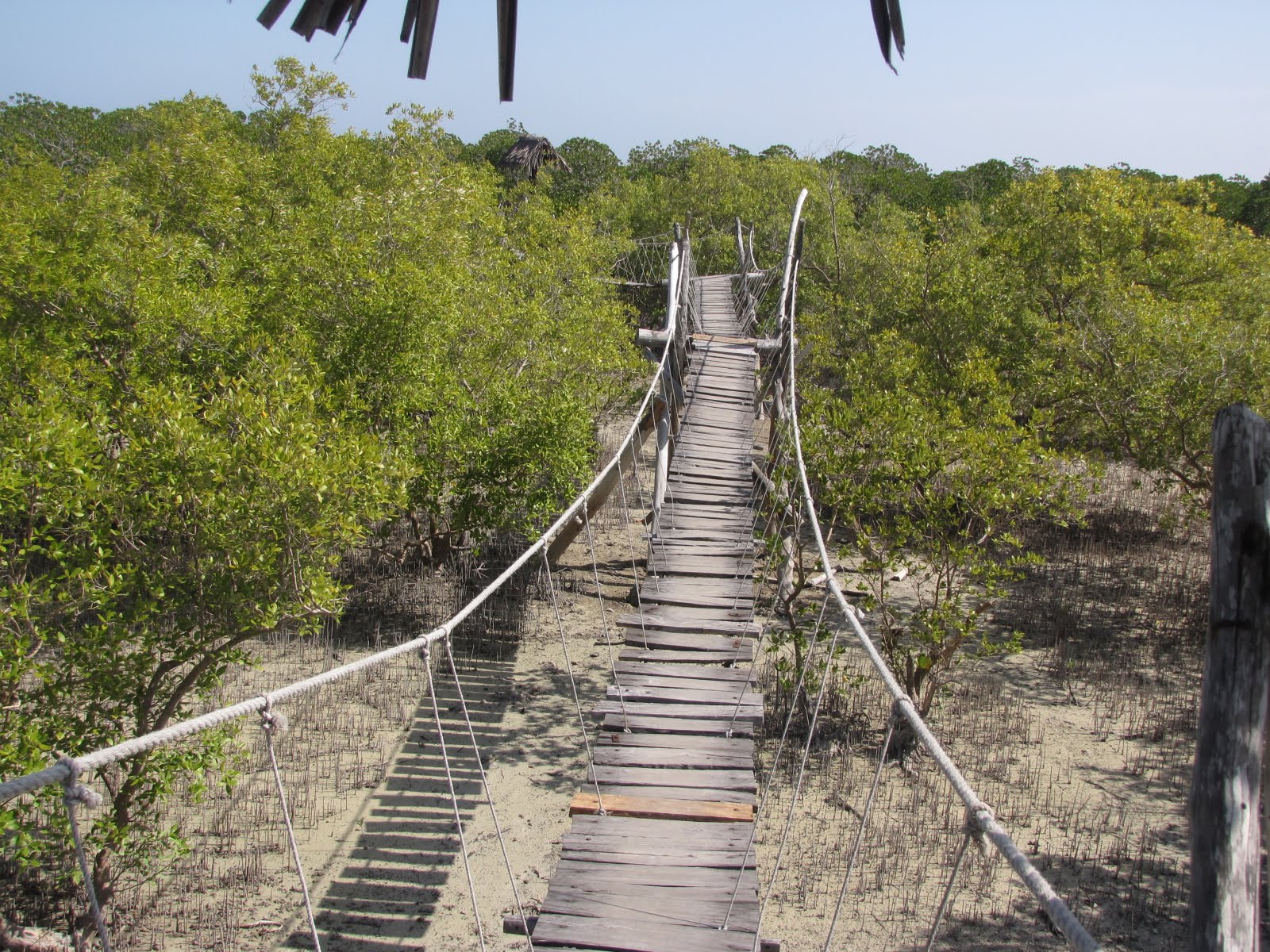
This 260m long suspended path allows
visitors a great view of the forest
To the east of Arabuko-Sokoke Forest and forming part of the same habitat, Mida Creek is one of Africa's largest mangrove creeks. Covering over 32 square kilometres, this tidal inlet forms part of a UNESCO Biosphere Reserve together with the forest. Situated between Kilifi and Malindi, the habitat provides an amazing opportunity to experience some of Africa's rarest wildlife and plants.

Designated an Important Biodiversity Area by NatureKenya, the forest and creek are linked by complex natural water flow systems, with the health of each habitat dependent on the other. This Creek is home to one of the most productive mangrove ecosystems on earth, a key stop-over and a significant feeding site for birds migrating from Europe, Asia and the Middle East to eastern and southern Africa. The birds feed on the variety of invertebrate food items buried in the muddy sand flats at low tide and roost on the exposed sandbanks and on the mangroves at high tide.

The best time to visit is late afternoon, ideally when this coincides with an incoming tide and a breadth-taking sunset.

After getting our tickets we were directed to the mangrove boardwalk (in itself worth a visit), an impressive structure made from a series of suspension bridges on steel ropes leading 260 metres through the mangrove canopy and ending at an elevated bird hide. Beware if you’re of a nervous disposition! Mida Creek is an excellent bird watching area, where a great variety of birds can be seen including waders, kingfishers and crab plovers.

EstherWambui/Photos
Heading out into the Creek in our canoe
Traditional dugout canoes, Arabic dhows and motorboats are used for bird watching, water skiing, fishing, relaxing boat cruises and sundowner trips on the Creek. We took our trip on a traditional canoe, guided by a thoroughly entertaining and informative “Captain Sulubu”. We rode out to Sudi Island to await the sunset and docked somewhere along the way to plant a few mangrove seeds; our simple contribution to the preservation of this uniquely amazing place.

Beyond the mangroves, beneath the open waters of the creek are submerged sea grass beds and coral reefs. These support a rich variety of marine organisms and fish spawning grounds, a vital source of food for wildlife and people alike. Although people no longer live inside Arabuko-Sokoke Forest, a large population of mostly Giriama people now live around the forest boundary. Most of these people are subsistence farmers, growing enough maize, cassava and beans for themselves and their families

Sadly, many threats face the forest and creek. Every day, timber and other natural resources are removed, often illegally, by local people as a means of earning money, largely to support their children's education. The creek habitats too are threatened by over-fishing, over- extraction of groundwater and over-harvesting of mangrove poles.

To counteract this damage, ASSETS (Arabuko-Sokoke Schools and Ecotourism Scheme), a programme managed jointly by A Rocha Kenya and the ASSETS committee, offers a creative solution to respond to the needs of local school children. They do this while encouraging community support for the protection of the largest remaining area of East African coastal forest.

EstherWambui/Photos
The magnificent Mida Creek sunsets
alone are worth the visit
ASSETS distributes funding from Eco-tourism to provide bursaries (scholarships) for secondary school children who would otherwise be unable to afford school fees. The ASSETS programme encourages the local people to value the forest and creek by equally distributing the benefits from eco-tourism throughout the local communities.

It is worth mentioning that at Mida Creek, I met the most respectable, honest, professional and friendly people of any touristic place I have been to in Kenya.

~With information from ASSETS-kenya.org and many thanks to Conservation Assistant Alex Thoya~

Wednesday, July 6, 2011

Give me an education, hopefully I'll afford a pair of shoes in future

Having a pair of shoes to wear to school for some children in Kenya is a privilege. For others, particularly in urban and semi-urban regions, regardless of social standing, it's rather understood that a school uniform includes shoes. But for some poor pupils and parents, the clothes make the uniform and that's that. Shoes, if available are a bonus; coming in all types, form and colour. It's not uncommon for pupils to go to school in patipatis [slippers].

A few years ago, it was that if you didn't afford shoes, you didn't go to school. This was because although unaffordable to some, shoes were still way cheaper than the cost of primary education. But with President Mwai Kibaki's landmark initiative to provide free primary education to every Kenyan since 2003, an additional 1.5 million children were reported to have enrolled in school for the first time.

Kenyans value education and will pursue it as long and as high as they can. So over the last few years, parents tolerated an influx in pupil enrolments, including some adult ones who only wanted to finally write/spell their names. Kenyans stood by as pupils out-numbered teachers and education standards fell to record lows. Books and teaching materials became scarce. Those with some cash to spare enrolled their children into the ever increasing private academies. The best teachers left their public employ for a more lucrative pay with the private sector. Still life seemed to be good.

Then, the beast that seems to stalk Kenya's Public Sector struck again. News media started reporting of yet another corruption scandal, this time at the Ministry of Education. A government audit revealed that over 4.2 billion shillings had disappeared from the Ministry. Embezzled!

As it stands now, the minister and permanent secretary at that ministry of Education have refused to resign. But, I’ll not go into corruption and its notoriety in Kenya. Instead, let me show you what theft, misuse and misappropriation of these funds has denied and will continue to deny Kenya's neediest pupils.

EstherWambui/Photos

I met these kids when I visited their school in Kibera a while back. When I see the innocence, beauty and hope in their eyes, I want to back our public officials into a corner and demand to know how they can continue with such impunity.
EstherWambui/Photos


I was in a bus touring Kilifi recently when I saw these pupils going home from school for lunch. In such scorching sun, I was really saddened by the fact that in this day and age, majority walked shoeless.

Friday, July 1, 2011

Reader Response

A reader's email comment to the June 28th article, "The 'water-boy' who made my heart ache". I decided to put up this image as it is very similar to mine in both content and context. It was also taken in Maiella.

Joseph Kiarie Wrote: I liked your article very much. Kuddos! I have this other picture I took and I hope you like it. Check it out.


Photo by JoseeyKiarie


Tuesday, June 28, 2011

The 'water-boy' who made my heart ache

EstherWambui/Photos

This image captures the eye. It may also catch you for its beauty: A donkey in full motion and a young boy doing his best to keep up, the stick in his hand to whip the donkey if it slows down. It's a beautiful image I think, the urgency of it expressed in its blurriness. But it is this urgency that is at the heart of my ache.

On the day I visited Maiella , it became apparent long before we arrived that water was scarce in this region. Along the way to my relatives’ place, we met every mode of transportation - boda boda, donkeys, women’s backs and bicycles - carrying one or more mitungis [Jerrycans] of water. Maiella suffers tremendous water shortage.

But what really drove the point home for me was actually observing the long queues for water at the World Vision water supply point.

For now though, let’s return to the running boy and donkey. The boy [let's call him Kamau] is still wearing his school uniform. It's around 5:30pm. He just came home from all-day school only to find empty water containers waiting for him. I imagine him hurriedly strapping the donkey and heading off to fetch water before darkness sets in. He doesn't have to be told to go for water, it's his daily after-school chore after all. It's also possible that he hasn't had any water to drink as the last drop was used up earlier in the day.

So off Kamau goes, running to the water point only to be terribly disappointed. Moments earlier, I had watched as some people were turned away because the water ran out. It's hard to comprehend how you'd feel after two hours of queuing, only to leave with dry containers. With no other option, the people grumbled on their way home, to make do with whatever little water if any they had left.

Kamau on the other hand couldn’t afford the luxury of returning home. He had to go for water from the next distribution point, an hour and a half one way walking distance. He wouldn’t be back before 9 P.M, I was informed.

EstherWambui/Photos
Standing aside while the crowd dispersed, I could only take pictures as I pondered their lifestyle. A life in which search for drinking water during the dry seasons apparently took up 3/4 of each and every waking day.

I asked around why there wasn't enough water for everyone who needed it. Obviously, the administrators could only pump water into the only available tank, which they did overnight. Some people were quick to blame the government, particularly local authorities. Apparently during the construction of the single tank, World Vision knew one tank wouldn’t cater to everyone's water needs. Yet, their application/request to build more tanks was denied. It is believed that the local authorities want the water shortage situation to continue so that they can charge higher than average for water - a corruption strategy that keeps their pockets well lined with ill-obtained cash.

So as it stands, the people of Maiella continue their daily struggle, looking forward to a short reprieve during the rainy season. It’s the only time they and their beasts of burden can take a breather while preparing for the next hot, dry, waterless season. For this season always comes.

Yet another critical area where Kibaki could have invested Kenya’s million bucks!

Tuesday, June 14, 2011

Revolting gesture or an act of kindness? You decide.

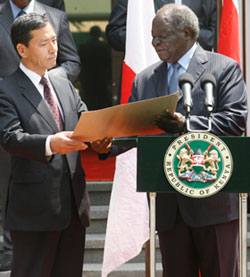
On May 30th President Mwai Kibaki of Kenya made a grand gesture. He donated one Million U.S. dollars to assist victims of the devastating earthquake and Tsunami that hit Japan in March this year.

Why is this an issue two weeks later? You may ask.

From the beginning, I admit that I thought that was about the dumbest, most insulting and revolting thing for Kibaki to do. Having only recently visited Kenya (I was watching the Japanese disaster unfold during a layover at Heathrow Airport), I know for a fact that there is so much more this money, approximately Kshs 82 million, could have done for Kenyans themselves.

President Mwai Kibaki presents a cheque of
one million US dollars to Japanese Ambassador
Photo Courtesy of Govedi Asutsa [The Standard Online]

I’ve also fished around amongst my friends and on the internet for opinion and comments regarding this donation. What do other people think?

There is minimal support for Kenya’s (read Kibaki’s) magnanimous gesture. When such support is expressed, it is in terms of pride, customs or religious belief. Pride that we Africans are for once giving instead of receiving aid, that we are generous peoples, and in biblical context, “blessed are those who give for they shall receive”.

But for majority whose opinion I sought, Kibaki’s giving away a million dollars; even in the name of post-quake support to victims is the biggest insult the president could have added to the citizenry’s injury. There is of course the obvious irony of such a poor, struggling third world nation donating to the world’s third-largest economy. While you are at it, compare this: Japan’s Gross National Income per capita at US $37,870 to Kenya’s meager US $770 (World Bank, 2009).

And for whatever reason, let's say Kibaki had to give out that money. Shouldn't he have at least done so closer to home – for example given an independence present to our neighbour South Sudan, Africa’s youngest nation?

But from what I observed in Kenya, I can only assume that Kibaki is afflicted by a condition for which I have coined the term Elite Syndrome or ES – whereby the country’s wealthy purposely live a completely isolated lifestyle. Hidden and incubated in their mansions & shopping malls by security guards and high fences, driven in tinted glass gas-guzzlers, they are immune (or at least pretend to be) to all the poverty, hunger, disease, and utter desperation outside their gates and in their backyards.

Take a look at some pictures I took referencing these areas of concern and tell me if there wouldn't have been a better/other way for Kibaki to spend a million bucks of poor taxpayers money!!

Sunday, June 5, 2011

Misconceptions about antiretroviral drugs hampering the dream for an AIDS-free generation

30 years since the first documented cases of HIV, there are reports of major milestones in the fight against an epidemic that has devastated some parts of the world. UNAids reports that in the last decade the global rate of infections dropped by nearly 25%, while according to the World Health Organization, an estimated 6.6 million people with HIV in developing countries are now on antiretroviral therapy drugs –drugs that keep them from developing Aids and help them live longer.

But as we hail the achievements of the last decade, one very important question begs an urgent answer: “Have we done enough to expect an AIDS-free generation any time soon?” As I’ve recently witnessed, complacency related to antiretroviral drugs may be fast eating into this dream.

EstherWambui/Photos
Participants at Toronto AIDS Walk For Life arrive
at the city's AIDS Memorial
A recent conversation with three young women in Kenya gave me a window into how far we might be from achieving that goal and left me wondering whether time has come to re-examine basic HIV/AIDS education [Esther Wambui/Photos].

I was concluding a visit there after five years of living abroad. And as it is customary I ended up at a hair salon for some braids that would take several hours to do. With so much time to pass, I eventually broached my favourite topic…HIV/AIDS. I instantly noticed something positively different. Unlike five years ago, people are no longer shy to discuss the epidemic. They have seen and heard enough about it already to become part of daily conversation. One of the women was in her mid-30s and she vehemently declared that if some guy thought to “bring” her HIV, she would personally kill him.

The other two women however, were in their early twenties and had a different tone. One said that she did all she could to avoid infection, but that accidents do happen anyway. Then the third woman made a statement that forms the crust of my viewpoint today. Unfazed by all our (ABCD*) talk, she boldly declared that medication for HIV was now available and there was no more need for all the panic. She went on to say that people should be left alone to “enjoy fear-free, guilt-free sex”.

I froze to my bone on hearing this. As a certified basic HIV/AIDS educator, I’m aware that antiretroviral therapy is an important part of the curriculum, with an emphasis on ARVs as one of a number of ways to enhance the life of sufferers. ARVs never have and do not cure AIDS or HIV for that matter.

Thus as we commemorate three decades of HIV, we need to remember the under-thirty generation, for whom the epidemic has always been a way of both vocabulary and life; a generation that didn’t have to deal with the shock-value of the emergence of an incurable disease. For them, HIV/AIDS is one of the many other chronic diseases.
EstherWambui/Photos
Two TCE [South Africa] Field Officers give an HIV/AIDS
awareness lesson to a teenage girl

Is it time to revisit the focus of ARVs education or do we need to implement an altogether new program?

While we must continue giving hope to those already infected, we need to make sure that the uninfected know all there is to know about these drugs. Let’s have an ARV-only program. A program that tells the young that yes ARVs are there. Yes, they are available although to a relatively small and select number in poor countries. And yes, they do improve the quality of life for the infected. Likewise, I believe time has come to revisit the education of earlier years. Be forthright, open, frank, and remind people that these drugs are not a cure.

Let emphasis be placed on the ills of long-term use of these drug: The numerous side effects that range from relatively mild ones, to very serious ones that in themselves impact quality of life. Add that to treatment failure, drug toxicity and in some cases, resistance to these drugs. This in itself should disturb the unfazed, the fact that once you’re on ARVs you’re always on ARVs. That you never stop taking them, a concoction of pills for the remainder of your life!

In the fight against HIV, we always hope that everyone gets the message. But as is the way of life, some people might or probably will always fall through the cracks. I’m okay with that as long as they fall knowing that crack is a life-altering one to fall into - one that you eventually pay for with your life.

With an estimated 33.3 million people currently living with the virus, the only thing I can hope for is that the young woman is by all means an exception, not an indicator of her generation’s mindset.

*Abstain, Be Faithful, Condomize, or Do-it-Yourself.

Monday, August 2, 2010

“Yes” or “No”, decision time for Kenya

One of the best advices anyone ever gave me was that it was likely that in immigrating I’d lose my sense of “belonging”. He said that while in my new country, I’d long for the country of my birth and vice versa. This is why after some struggle I have quit trying to either be fully Kenyan or wholly Canadian; recognizing it will never happen. For the rest of my life, I unashamedly expect to be satisfied with the hybrid third personality, sometimes 50:50 and other times 70:30, the ratio often depending on the day and the news headlines.

I can therefore confess that in recent days and up until Wednesday this week, I have been and expect to be more Kenyan than Canadian. Instead of joining in the jingle “to bring back the long-form census”, I have turned to constantly scouring news channels regarding the proposed Kenyan constitution which will be subjected to a referendum on August 4, 2010.

You cannot blame Kenyans in the diaspora for selfishly wanting this draft constitution to pass. The main reason is that one of the clauses guarantees that Kenyan citizens who acquire foreign citizenship will not lose their Kenyan citizenship. Considering that most of our families remain in Kenya and that Kenyans abroad contribute significantly to nation-building through direct financial remittances, a dual citizenship seems like a fair deal.

But looking at the bigger picture, we out here support by all means a constitution that will help Kenya improve its poor democracy as well as avoid a repeat of the 2007-08 violence which rocked the country following disputed national elections. With only two years till the next polls, Kenyans cannot afford any more senseless politicking.

It appears though that majority of Kenyans are in support of the new constitution.

Although campaigns for both the “Yes” and “No” camps have been intense, Kenyan groups and political leaders have been keen to avoid violence. But, there have been a few glitches. For instance; at a rally against the constitution in downtown Nairobi in June, grenade attacks killed six people, while a number of politicians have been charged with hate speech for inciting crowds. There have also been reports of distributed leaflets threatening violence.

Another reason the draft constitution seems to garner wide support among Kenyans is that it cuts down the president's enormous powers by setting up a presidential system with checks and balances. This is important because, 47 years after independence, one of the country’s main sources of tension remains the unequal distribution of resources; with consequent presidents being accused of favouring their tribesmen.

There is of course some opposition to the new constitution, particularly from church groups who fear it opens up the issue of abortion. They argue the abortion clause — which says abortion is not permitted unless the life or health of the mother is in danger according to the opinion of a trained health professional — could be interpreted broadly. [This is despite the proposed constitution not changing the current legality of abortion only for maternal health]. Another clause considered contentious is the inclusion of Kadhis Courts - publicly funded family courts for Muslims.

In 2005, Kenya held a referendum on a draft constitution, but it was shot down. This time around, rewriting the constitution was part of the peace deal signed in February 2008 between President Mwai Kibaki and PM Raila Odinga, who are both in support of this proposed constitution.

The way I see it albeit from outside, a yes vote will push Kenya into the future, where the country can finally embark into other issues of nation-building. Since we seem unable to correct the past, let us at least pursue a better future for all Kenyans.

Thus on this day, with only a virtual vote, I back the “Yes” campaign.