Tuesday, June 28, 2011

The 'water-boy' who made my heart ache

EstherWambui/Photos

This image captures the eye. It may also catch you for its beauty: A donkey in full motion and a young boy doing his best to keep up, the stick in his hand to whip the donkey if it slows down. It's a beautiful image I think, the urgency of it expressed in its blurriness. But it is this urgency that is at the heart of my ache.

On the day I visited Maiella , it became apparent long before we arrived that water was scarce in this region. Along the way to my relatives’ place, we met every mode of transportation - boda boda, donkeys, women’s backs and bicycles - carrying one or more mitungis [Jerrycans] of water. Maiella suffers tremendous water shortage.

But what really drove the point home for me was actually observing the long queues for water at the World Vision water supply point.

For now though, let’s return to the running boy and donkey. The boy [let's call him Kamau] is still wearing his school uniform. It's around 5:30pm. He just came home from all-day school only to find empty water containers waiting for him. I imagine him hurriedly strapping the donkey and heading off to fetch water before darkness sets in. He doesn't have to be told to go for water, it's his daily after-school chore after all. It's also possible that he hasn't had any water to drink as the last drop was used up earlier in the day.

So off Kamau goes, running to the water point only to be terribly disappointed. Moments earlier, I had watched as some people were turned away because the water ran out. It's hard to comprehend how you'd feel after two hours of queuing, only to leave with dry containers. With no other option, the people grumbled on their way home, to make do with whatever little water if any they had left.

Kamau on the other hand couldn’t afford the luxury of returning home. He had to go for water from the next distribution point, an hour and a half one way walking distance. He wouldn’t be back before 9 P.M, I was informed.

EstherWambui/Photos
Standing aside while the crowd dispersed, I could only take pictures as I pondered their lifestyle. A life in which search for drinking water during the dry seasons apparently took up 3/4 of each and every waking day.

I asked around why there wasn't enough water for everyone who needed it. Obviously, the administrators could only pump water into the only available tank, which they did overnight. Some people were quick to blame the government, particularly local authorities. Apparently during the construction of the single tank, World Vision knew one tank wouldn’t cater to everyone's water needs. Yet, their application/request to build more tanks was denied. It is believed that the local authorities want the water shortage situation to continue so that they can charge higher than average for water - a corruption strategy that keeps their pockets well lined with ill-obtained cash.

So as it stands, the people of Maiella continue their daily struggle, looking forward to a short reprieve during the rainy season. It’s the only time they and their beasts of burden can take a breather while preparing for the next hot, dry, waterless season. For this season always comes.

Yet another critical area where Kibaki could have invested Kenya’s million bucks!

Tuesday, June 14, 2011

Kenya: Critical areas where a million dollars might just make a difference:-

Water Provision


Esther Wambui/Photos.
A "mkokoteni" carrier sells water in Mombasa City.

EstherWambui/Photos
I met this girl beside a well in Kilifi, where it appears she
had just about drawn the last drop.

Esther Wambui/Photos
I went to Maiella, a rural farming region West of Naivasha and I have to say that I've never known or seen such shortage of water. People spend a minimum of four hours a day walking to and from a water source. Sometimes, as this photo indicates, international aid organizations [in this case World Vision] end up doing what local/national governments should do for their citizens.

Revolting gesture or an act of kindness? You decide.

On May 30th President Mwai Kibaki of Kenya made a grand gesture. He donated one Million U.S. dollars to assist victims of the devastating earthquake and Tsunami that hit Japan in March this year.

Why is this an issue two weeks later? You may ask.

From the beginning, I admit that I thought that was about the dumbest, most insulting and revolting thing for Kibaki to do. Having only recently visited Kenya (I was watching the Japanese disaster unfold during a layover at Heathrow Airport), I know for a fact that there is so much more this money, approximately Kshs 82 million, could have done for Kenyans themselves.

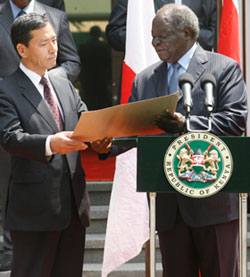
President Mwai Kibaki presents a cheque of
one million US dollars to Japanese Ambassador
Photo Courtesy of Govedi Asutsa [The Standard Online]

I’ve also fished around amongst my friends and on the internet for opinion and comments regarding this donation. What do other people think?

There is minimal support for Kenya’s (read Kibaki’s) magnanimous gesture. When such support is expressed, it is in terms of pride, customs or religious belief. Pride that we Africans are for once giving instead of receiving aid, that we are generous peoples, and in biblical context, “blessed are those who give for they shall receive”.

But for majority whose opinion I sought, Kibaki’s giving away a million dollars; even in the name of post-quake support to victims is the biggest insult the president could have added to the citizenry’s injury. There is of course the obvious irony of such a poor, struggling third world nation donating to the world’s third-largest economy. While you are at it, compare this: Japan’s Gross National Income per capita at US $37,870 to Kenya’s meager US $770 (World Bank, 2009).

And for whatever reason, let's say Kibaki had to give out that money. Shouldn't he have at least done so closer to home – for example given an independence present to our neighbour South Sudan, Africa’s youngest nation?

But from what I observed in Kenya, I can only assume that Kibaki is afflicted by a condition for which I have coined the term Elite Syndrome or ES – whereby the country’s wealthy purposely live a completely isolated lifestyle. Hidden and incubated in their mansions & shopping malls by security guards and high fences, driven in tinted glass gas-guzzlers, they are immune (or at least pretend to be) to all the poverty, hunger, disease, and utter desperation outside their gates and in their backyards.

Take a look at some pictures I took referencing these areas of concern and tell me if there wouldn't have been a better/other way for Kibaki to spend a million bucks of poor taxpayers money!!