Today I didn’t call anyone since the electronic voice declared me short of tarjeta or “air time”. Instead I spent the day catching up on tasks that were long overdue, although I somehow couldn’t put in more than an hour to improve my seriously deficient Spanish. It has been an uneventful day, unlike the week, or indeed the past month since I made the move to Ecuador [for reasons that I’ll be getting into later]. For now, let me introduce you to this place that I hope to make my home for some time.
Yesterday in a routine conversation with a friend, I learnt that when she hired her new domestic help, the woman wanted to know where “her special utensils” were and in what room she was expected to eat her lunch, since with her previous employers she was not allowed to share these. Later, I went to a meeting in one of Quito’s “most secure neighbourhoods” where my friends had their car broken into, in broad daylight. During the same meeting, an acquaintance used a popular quote to warn me of road dangers here. Apparently, "Ecuadorian cemeteries are filled with people who had the right of way".
The day before, an acquaintance showed up for a meeting 40 minutes late and as he took his seat, all he said to us was, “buenas tardes”. No apology or regret. As with Kenya’s “hakuna matata”, things in Ecuador get done, in their own time, “Manana, Manana, sin falta”. As if that was not enough for the day, a driver in front of us held the traffic for about 5 minutes because he decided to buy lottery tickets from a street vendor.
Last weekend 11 USDs gave me four bags full of fresh, juicy, tropical and exotic fruit. I attended mass at an altitude so high my ears popped, and had supper in a room overlooking the magnificent Cotopaxi Mountain.
Map of Ecuador Courtesy of Fundacion Bolivar Education.
Three weeks ago, I straddled the globe as I stood at “la mitad del mundo” or the middle of the world and toured Cuenca, a charming and bustling city, a UNESCO World Heritage Site, also home to Ingapirca the most significant archaeological site in Ecuador.
From chilly Andean slopes to a humid amazon basin, and majestic snow-capped peaks that descend into beautiful beaches, Ecuador’s climatic and geographic diversity is simply astounding.
Come journey with me through Ecuador, a dazzling country of extraordinary contradictions. As I live and discover my new home, I hope you allow me the honour of taking you along with me. Although I have been coming here since 2008, this time round, I hope that I can get beyond the tourist eye and simple journalistic curiosity to reach a place where I can call this land, “my home away from home”.
Friday, September 16, 2011
Wednesday, September 7, 2011
Mida Creek, a rare mangrove gem on Kenya’s coast
Whenever I mention that I’m from Kenya, the first thing most people want to know is if I’ve visited any animal park; Maasai Mara, Amboseli, Samburu, Nakuru, others even include Serengeti [which is in Tanzania]. I am also quick to add that we have beautiful beaches for the sun bummers. But until recently, I omitted a rare gem tucked right at the heart of the spectacular sandy beaches. This place is Mida Creek. I took a trip there earlier in the year and I was rather surprised that the place does not feature more prominently in what foreigner know about Kenya.
To the east of Arabuko-Sokoke Forest and forming part of the same habitat, Mida Creek is one of Africa's largest mangrove creeks. Covering over 32 square kilometres, this tidal inlet forms part of a UNESCO Biosphere Reserve together with the forest. Situated between Kilifi and Malindi, the habitat provides an amazing opportunity to experience some of Africa's rarest wildlife and plants.
Designated an Important Biodiversity Area by NatureKenya, the forest and creek are linked by complex natural water flow systems, with the health of each habitat dependent on the other. This Creek is home to one of the most productive mangrove ecosystems on earth, a key stop-over and a significant feeding site for birds migrating from Europe, Asia and the Middle East to eastern and southern Africa. The birds feed on the variety of invertebrate food items buried in the muddy sand flats at low tide and roost on the exposed sandbanks and on the mangroves at high tide.
The best time to visit is late afternoon, ideally when this coincides with an incoming tide and a breadth-taking sunset.
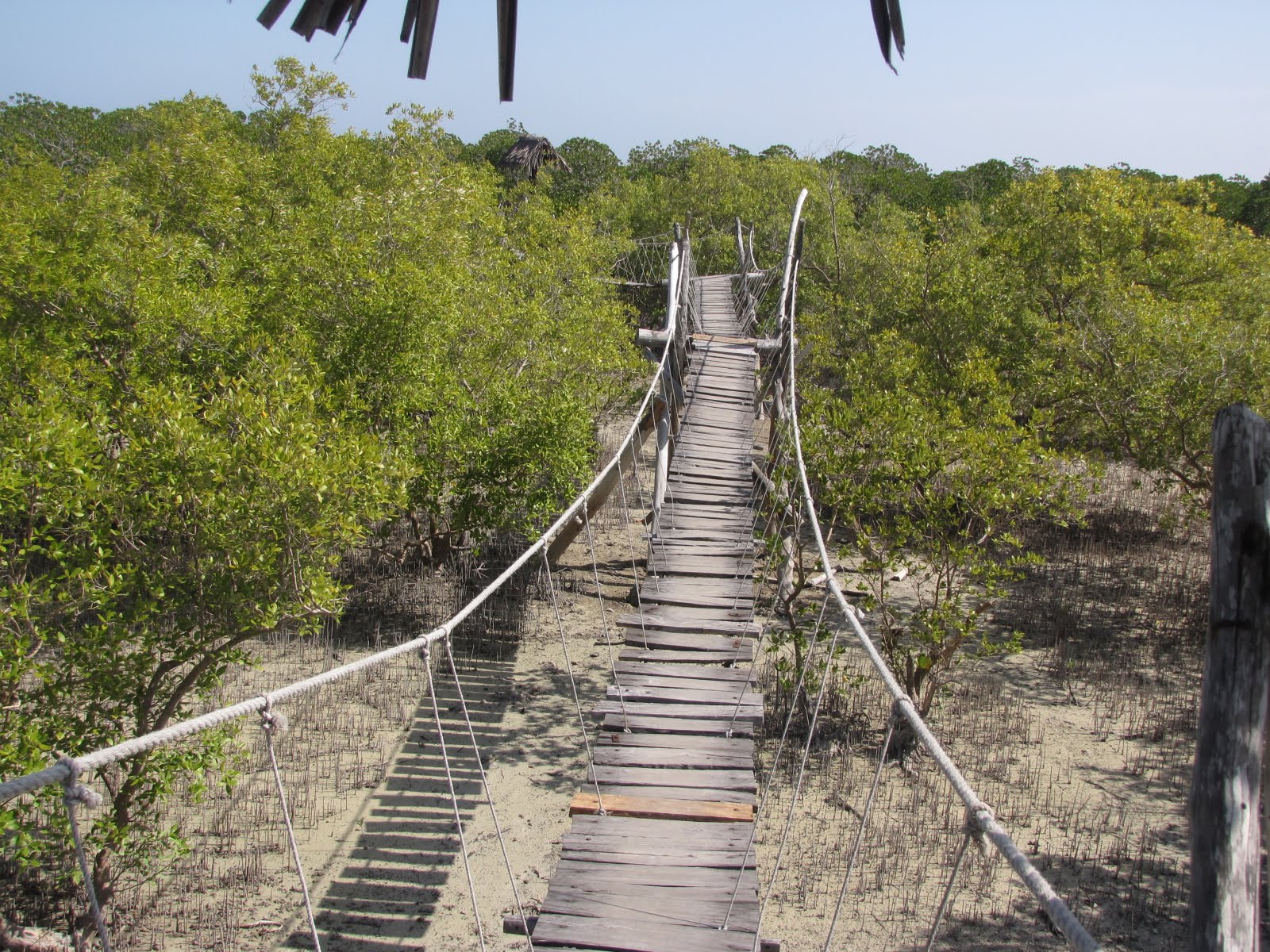
After getting our tickets we were directed to the mangrove boardwalk (in itself worth a visit), an impressive structure made from a series of suspension bridges on steel ropes leading 260 metres through the mangrove canopy and ending at an elevated bird hide. Beware if you’re of a nervous disposition! Mida Creek is an excellent bird watching area, where a great variety of birds can be seen including waders, kingfishers and crab plovers.
Traditional dugout canoes, Arabic dhows and motorboats are used for bird watching, water skiing, fishing, relaxing boat cruises and sundowner trips on the Creek. We took our trip on a traditional canoe, guided by a thoroughly entertaining and informative “Captain Sulubu”. We rode out to Sudi Island to await the sunset and docked somewhere along the way to plant a few mangrove seeds; our simple contribution to the preservation of this uniquely amazing place.
Beyond the mangroves, beneath the open waters of the creek are submerged sea grass beds and coral reefs. These support a rich variety of marine organisms and fish spawning grounds, a vital source of food for wildlife and people alike. Although people no longer live inside Arabuko-Sokoke Forest, a large population of mostly Giriama people now live around the forest boundary. Most of these people are subsistence farmers, growing enough maize, cassava and beans for themselves and their families
Sadly, many threats face the forest and creek. Every day, timber and other natural resources are removed, often illegally, by local people as a means of earning money, largely to support their children's education. The creek habitats too are threatened by over-fishing, over- extraction of groundwater and over-harvesting of mangrove poles.
To counteract this damage, ASSETS (Arabuko-Sokoke Schools and Ecotourism Scheme), a programme managed jointly by A Rocha Kenya and the ASSETS committee, offers a creative solution to respond to the needs of local school children. They do this while encouraging community support for the protection of the largest remaining area of East African coastal forest.
ASSETS distributes funding from Eco-tourism to provide bursaries (scholarships) for secondary school children who would otherwise be unable to afford school fees. The ASSETS programme encourages the local people to value the forest and creek by equally distributing the benefits from eco-tourism throughout the local communities.
It is worth mentioning that at Mida Creek, I met the most respectable, honest, professional and friendly people of any touristic place I have been to in Kenya.
~With information from ASSETS-kenya.org and many thanks to Conservation Assistant Alex Thoya~
![]() |
| EstherWambui/Photos This 260m long suspended path allows visitors a great view of the forest |
Designated an Important Biodiversity Area by NatureKenya, the forest and creek are linked by complex natural water flow systems, with the health of each habitat dependent on the other. This Creek is home to one of the most productive mangrove ecosystems on earth, a key stop-over and a significant feeding site for birds migrating from Europe, Asia and the Middle East to eastern and southern Africa. The birds feed on the variety of invertebrate food items buried in the muddy sand flats at low tide and roost on the exposed sandbanks and on the mangroves at high tide.
The best time to visit is late afternoon, ideally when this coincides with an incoming tide and a breadth-taking sunset.
After getting our tickets we were directed to the mangrove boardwalk (in itself worth a visit), an impressive structure made from a series of suspension bridges on steel ropes leading 260 metres through the mangrove canopy and ending at an elevated bird hide. Beware if you’re of a nervous disposition! Mida Creek is an excellent bird watching area, where a great variety of birds can be seen including waders, kingfishers and crab plovers.
![]() |
| EstherWambui/Photos Heading out into the Creek in our canoe |
Beyond the mangroves, beneath the open waters of the creek are submerged sea grass beds and coral reefs. These support a rich variety of marine organisms and fish spawning grounds, a vital source of food for wildlife and people alike. Although people no longer live inside Arabuko-Sokoke Forest, a large population of mostly Giriama people now live around the forest boundary. Most of these people are subsistence farmers, growing enough maize, cassava and beans for themselves and their families
Sadly, many threats face the forest and creek. Every day, timber and other natural resources are removed, often illegally, by local people as a means of earning money, largely to support their children's education. The creek habitats too are threatened by over-fishing, over- extraction of groundwater and over-harvesting of mangrove poles.
To counteract this damage, ASSETS (Arabuko-Sokoke Schools and Ecotourism Scheme), a programme managed jointly by A Rocha Kenya and the ASSETS committee, offers a creative solution to respond to the needs of local school children. They do this while encouraging community support for the protection of the largest remaining area of East African coastal forest.
![]() |
| EstherWambui/Photos The magnificent Mida Creek sunsets alone are worth the visit |
It is worth mentioning that at Mida Creek, I met the most respectable, honest, professional and friendly people of any touristic place I have been to in Kenya.
~With information from ASSETS-kenya.org and many thanks to Conservation Assistant Alex Thoya~
Thursday, July 21, 2011
In Africa, Let Charity Begin at Home
The African/Horn of Africa/East Africa/ Somali drought/famine is in the headlines although so far news writers here seem unsure of what to call that region. Still, we give more priority to JLo-Marc Anthony's divorce, the heat wave currently baking most of North America, European debt crises, the possibility of the U.S defaulting on its debt, and of course, how that will affect the global economy.
Here in Canada, a Royal Bank report suggests that Canadians are tightening their belts so they can handle rising consumer prices particularly for gas and food -29.5 per cent and 4.2 per cent in May respectively. Although this is nowhere near the 240 per cent increase in food prices seen in Somalia in the last month, it's nonetheless quite significant.
It comes as no wonder then, that some comments about the East African drought are less than pleasant. From relatively reasonable readers calling on rappers to give up their bling and feed their kin, to “oh not again, haven't we been feeding them long enough already”, to “if they can pop out so many kids they should have the means to feed them”, to the downright ignorant who say that those people should "put everything on their credit card like we do here and pay it off later".
The catastrophe and its consequences then gets on the news lineup yet can’t quite make the headlines. The rare times the story leads, it involves some Westerner, head or spokesperson of this or other NGO addressing a news conference regarding the drought.
Simply said, donor empathy is at its lowest. People are dealing with enough of their own problems and feel that "those" people should already be self-reliant.
But to be fair, there are lots of Good Samaritans out there including the Somali community here; MDs, “Friends of Somalia”, and Canadian Somali youth have been actively involved in raising funds or sending help any way they can to their countrymen in Africa.
With all due respect, I acknowledge the many factors that have brought the situation to where it is today. War/insecurity, an endemic cycle of poverty, corruption, mismanagement and misappropriation of funds particularly by local governments and the biggest one in this case the failure of rain. Simply put, these agriculturalists and nomadic pastoralist communities rely mainly on rain, and it has barely rained in the last two years.
So what has brought about this donor apathy? Here is what I think: It's just been so many years of donating without show of good result. The truth is, there is lots of good/positive result, but you have to be on the ground to see it. The failure of the media and the strategy of NGOs to mainly only air desperate images, continues to feed the society with the wrong image, an image of people who are endemically needy.
Donors rush to aid people and countries affected by natural disaster. But in this case, the disaster is clouded over by insecurity and a war that has gone on too long. Meaning that people see it as a disaster brought on by human [in]action. The world has just about ignored Somalia for the last twenty years and there is no sign this will change any time soon.
Most importantly, donors in the West can now observe what is going on out there. Although there’s still a lot of ignorance about Africa, the internet and social media has tremendously helped the curious see beyond the cleanly edited mainstream media images. Some now know that Africa is made up of many countries – 54 including the new South Sudan. They also know that not all those people and nations are dirt poor. So what they and I want to know is: “Where is the rest of Africa?” What are they doing to ease the burden of hunger on their drought-stricken brothers and sisters?
Southern, West, North, Central and the rest of East Africa, could we see you act? You may not have much, but you could spare some to save lives, especially those of children who may not last till the next bag of corn arrives from abroad. After all, it’s you who teach the same children that “Charity begins at home”. Or does it?
Here in Canada, a Royal Bank report suggests that Canadians are tightening their belts so they can handle rising consumer prices particularly for gas and food -29.5 per cent and 4.2 per cent in May respectively. Although this is nowhere near the 240 per cent increase in food prices seen in Somalia in the last month, it's nonetheless quite significant.
It comes as no wonder then, that some comments about the East African drought are less than pleasant. From relatively reasonable readers calling on rappers to give up their bling and feed their kin, to “oh not again, haven't we been feeding them long enough already”, to “if they can pop out so many kids they should have the means to feed them”, to the downright ignorant who say that those people should "put everything on their credit card like we do here and pay it off later".
The catastrophe and its consequences then gets on the news lineup yet can’t quite make the headlines. The rare times the story leads, it involves some Westerner, head or spokesperson of this or other NGO addressing a news conference regarding the drought.
![]() |
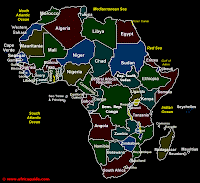
| Map of Africa Courtesy of Africaguide.com |
But to be fair, there are lots of Good Samaritans out there including the Somali community here; MDs, “Friends of Somalia”, and Canadian Somali youth have been actively involved in raising funds or sending help any way they can to their countrymen in Africa.
With all due respect, I acknowledge the many factors that have brought the situation to where it is today. War/insecurity, an endemic cycle of poverty, corruption, mismanagement and misappropriation of funds particularly by local governments and the biggest one in this case the failure of rain. Simply put, these agriculturalists and nomadic pastoralist communities rely mainly on rain, and it has barely rained in the last two years.
So what has brought about this donor apathy? Here is what I think: It's just been so many years of donating without show of good result. The truth is, there is lots of good/positive result, but you have to be on the ground to see it. The failure of the media and the strategy of NGOs to mainly only air desperate images, continues to feed the society with the wrong image, an image of people who are endemically needy.
Donors rush to aid people and countries affected by natural disaster. But in this case, the disaster is clouded over by insecurity and a war that has gone on too long. Meaning that people see it as a disaster brought on by human [in]action. The world has just about ignored Somalia for the last twenty years and there is no sign this will change any time soon.
Most importantly, donors in the West can now observe what is going on out there. Although there’s still a lot of ignorance about Africa, the internet and social media has tremendously helped the curious see beyond the cleanly edited mainstream media images. Some now know that Africa is made up of many countries – 54 including the new South Sudan. They also know that not all those people and nations are dirt poor. So what they and I want to know is: “Where is the rest of Africa?” What are they doing to ease the burden of hunger on their drought-stricken brothers and sisters?
Southern, West, North, Central and the rest of East Africa, could we see you act? You may not have much, but you could spare some to save lives, especially those of children who may not last till the next bag of corn arrives from abroad. After all, it’s you who teach the same children that “Charity begins at home”. Or does it?
Subscribe to:
Posts (Atom)